

























John Howard Benson, 1901–1956, calligrapher, stone carver, author, educator.
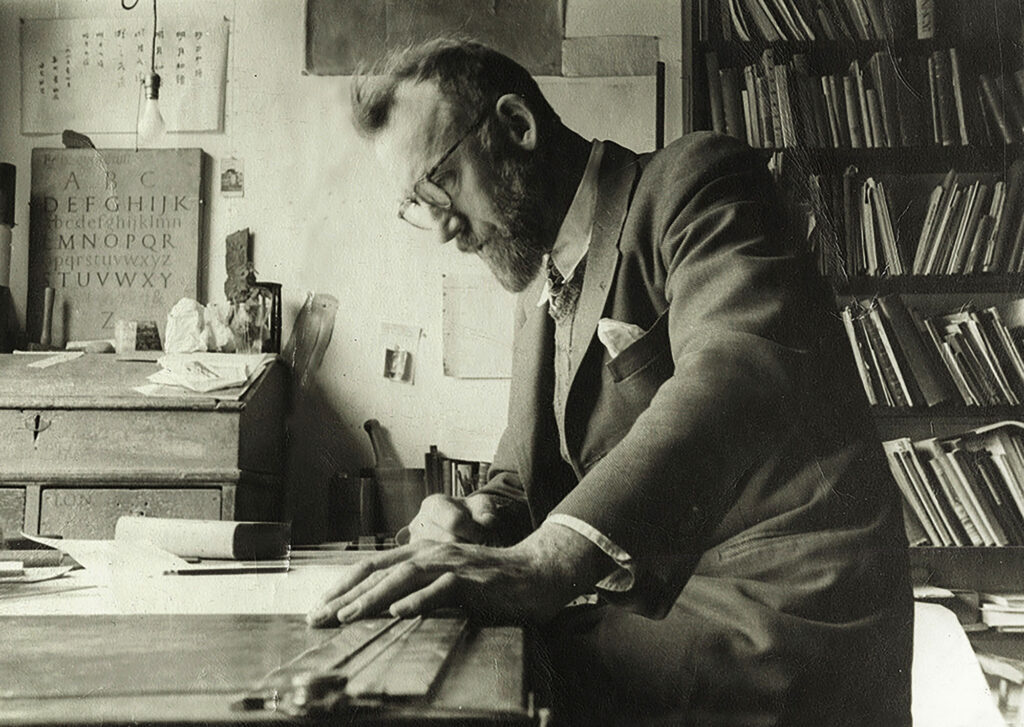

A consummate and supremely dedicated craftsman and artist, John Howard Benson was often compared to medieval or renaissance masters because of his fidelity to the seemingly ancient techniques he used in his work. In 1928, he acquired The John Stevens Shop, a stone carving business founded in 1705, where three generations of Stevenses were followed by three generations (and counting) of Bensons. John Howard Benson’s books, The Elements of Lettering (1940), co-authored by Arthur Graham Carey, and a hand-written translation of Arrighi’s Operina (1955), contributed mightily to the revival of calligraphy in the twentieth century. Benson headed the sculpture department at the Rhode Island School of Design from 1936 until his death.
On November 21, 1953, a day-long conference on lettering and architecture took place “at the new Yale Fine Arts Center,”1“News,” Industrial Design, February 1954, p 18. presumably the Yale Art Gallery, designed by Louis I. Kahn and completed earlier in the year. Ismar David was among the “90 architects, graphic designers and Yale art students”2“News,” Industrial Design, February 1954, p 18. who attended. In an undated draft3Here, very slightly edited for spelling, punctuation and syntax. for a calligraphy workshop, David spoke of the event:
“I specifically remember one symposium which I attended as a member of the audience. Its theme was lettering as a part of the cityscape. We listened to such greats of that period as Eero Saarinen, the architect, and Alvin Lustig, the designer. Both were deeply involved in the aesthetics of the nineteen fifties. While they thought to preach functionalism, they really talked about aesthetics which were supposed to evoke feelings of the functional. It seemed to be of great importance that letters appearing on signs were fashioned after even-stroke models. Considerations such as their size, their proportions and their spacing, as well as the optimal placing of lettered communications, were neglected despite their functional importance.
In this atmosphere, the first afternoon speaker, John Howard Benson, delivered what turned out to be a demonstration rather than a lecture. He is known to have devoted his career to the contemporary interpretation of classic Roman capitals. Slates which carry his lettering are unsurpassed. He used to write out their texts with a broad brush directly on the stone surface, to incise them afterwards [himself] or [have] his gifted assistant do so.
On that afternoon, standing in front of a blackboard with a piece of chalk in his hand, he stated that after the previous speakers had stressed the aesthetic, architectural and environmental aspects of communications through the medium of letterforms, he felt the need to make the audience aware of what he considered basic and he proceeded to demonstrate the form principles and proportions of the characters which form the alphabet of Roman capitals. He used his piece of chalk with restraint, resisting the temptation of adding calligraphic refinements which help to hold the interest of an average audience, but can distract the serious student.”